Skip to content
Back to selected work

01 / Payments infrastructure

Novasend

A fintech platform for fast, secure Mobile Money payments across Orange Money, Moov Money, MTN MoMo, and Wave.

Role
Backend engineering
Focus
Payment orchestration
Timeline
2023 — Present
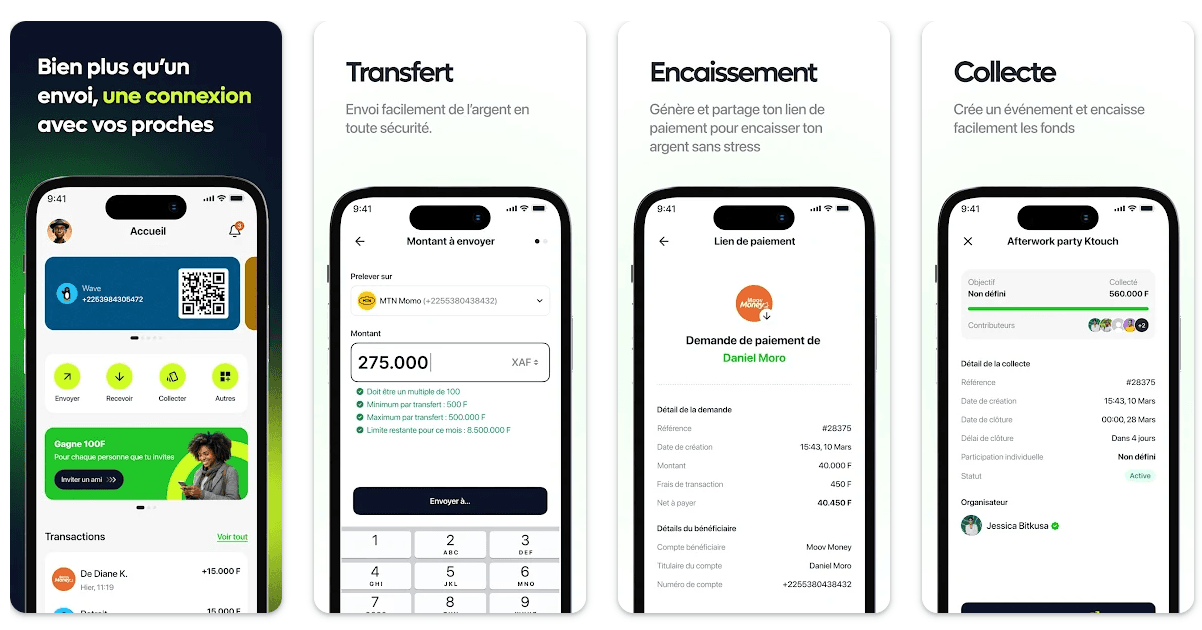
Novasend payment platform interface

Context and challenge

Mobile Money is a daily payment method across Côte d’Ivoire, but each provider exposes its own flows, constraints, and transaction states. For a merchant, that fragmentation creates unnecessary operational work: collecting a payment should not require a different customer journey for every network.

Novasend brings those rails into one product experience. The challenge was to make payment collection feel consistent while preserving the provider-specific behavior needed underneath. The platform also had to give both the payer and the merchant a clear view of a transaction from initiation to completion.

My role and scope

My contribution focused on backend engineering and the payment integration layer. I worked on the capabilities that connect the product experience to Mobile Money providers and expose them through dependable application flows.

The scope covered:

  • multi-provider Mobile Money integrations;
  • payment links and QR-based collection;
  • instant transfer flows;
  • transaction status tracking;
  • backend foundations used by the product interfaces.

Engineering approach

The backend was organized around stable payment capabilities instead of letting provider-specific concepts leak into every product feature. Each integration could retain its own requirements, while the rest of the application worked with a consistent transaction model.

That separation matters because providers evolve independently. Keeping their differences behind clear boundaries makes a new integration easier to add, limits the impact of change, and gives product flows a predictable contract.

Transaction visibility was treated as part of the product—not as an implementation detail. A payment can move through several intermediate states, so the platform needs one understandable lifecycle that can be reflected consistently in the interface.

Key decisions

  • Normalize the product flow. Provider differences belong in the integration boundary, not in every screen or business rule.
  • Keep transaction state explicit. A visible lifecycle makes support, reconciliation, and the customer experience easier to reason about.
  • Design for multiple entry points. Payment links, QR codes, and transfers reuse the same core capabilities instead of becoming isolated implementations.
  • Protect the payment boundary. External integrations are handled as untrusted boundaries, with input validation and controlled state changes at the center of the design.

Outcome and next steps

Novasend provides a unified way to collect and follow Mobile Money payments across Orange Money, Moov Money, MTN MoMo, and Wave. Merchants can use payment links, QR payments, and transfers without rebuilding a separate journey for each provider.

The next engineering priorities are continued observability around provider behavior, stronger reconciliation tooling, and keeping integrations isolated as the platform expands. Those investments preserve the simplicity of the product while the infrastructure underneath becomes more capable.

Next case study

Allo Driver

Backend services and an admin console for a vehicle rental product, designed around the team’s day-to-day operations.